Wolfgang Amadeus Mozart (27 January 1756 – 5 December 1791) was one of the most influential, popular and prolific composers of the classical period. A child prodigy, from an early age he began composing over 600 works, including some of the most famous pieces of symphonic, chamber, operatic, and choral music.
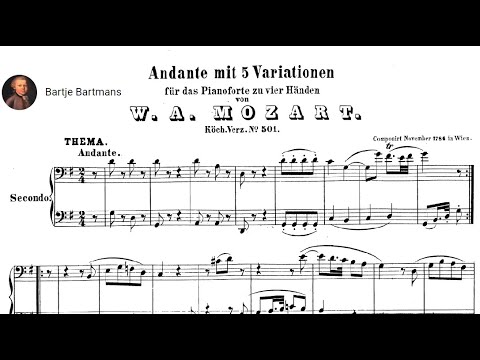
Variations (5) on an original theme for piano, 4 hands in G major, K. 501. Vienna, 4 November, 1786
Ingrid Haebler & Ludwig Hoffmann, piano
Description by Brian Robins
Following the successful production of “Le Nozze di Figaro” in May 1786, Mozart contemplated the possibility of a trip to England. It was an idea that came to nothing, and his next trip abroad was the highly successful visit to Prague in January 1787. With the notable exception of the String Quartet in D, K499, and the Symphony No.38 in D, composed in preparation for the visit to Prague and which now bears the name of that city, Mozart’s catalog entries for the latter months of 1786 show that he was much involved with the piano. In addition to the majestic Piano Concerto in C, K503, three trios featuring the instrument (the Piano Trios in G, K496 and B Flat, K502, and the delicious Clarinet Trio E Flat), and two sets of variations also date from this period. The present set is based on an unidentified theme that was probably composed by Mozart himself. Surviving sketches show that his original intention had been to compose the work for two pianos, but he later reverted to the four hand version published by Hoffmeister in Vienna the following year.