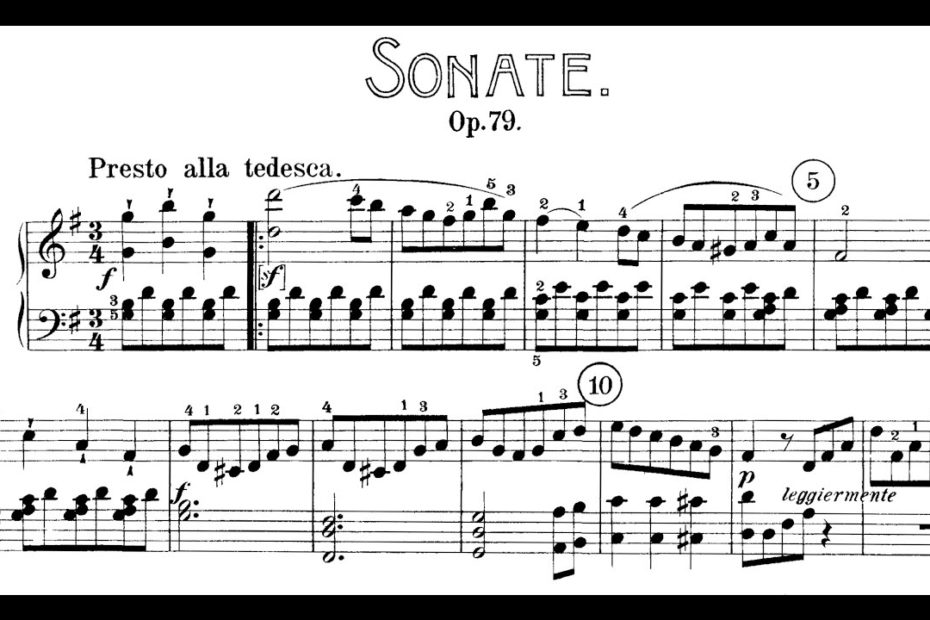
I’ve got a real soft spot for this sonata: it’s the shortest of the three-movement sonatas and contains no emotional extremities, no bravura, no structural extravagance, no demonstrations of new technique or sonority (despite coming after the radically new Appassionata). And yet this sonata is beautiful, because what it is is a completely spontaneous and unforced expression of joy (listen to 23:52 – the whole coda is wonderful). It’s the kind of thing you enjoy from the first listen and love from the second, and which you never have to struggle with at any point. In that way it’s like Mozart at his best.
This sonata is also one of those rare things that’s more or less interpretively bulletproof: it works at all kinds of tempi, with all kinds of dynamic additions and articulations: it’ll end up sounding gently humorous, or lyrical, or even dramatic, but whatever it is it’ll sound pretty good.
The nickname “Cuckoo” comes from the second and third notes of the first movement (a descending third), whose harmonic elaboration in the development and use in the coda have the feel of the eponymous bird-call (see 1:14 for a lithe Haydn-esque treatment, 10:46 for a lyrical treatment, and 20:41 for a motoric, dry treatment). Interestingly the “Cuckoo” motif (well, a third) is also important to the second movement (it is the decisive interval of not just the G min theme but also the Eb maj middle section of the Andante) and the third (all those thirds in the beginning of the Vivace).
Another point of interest is the modulatory sequence in the first movement’s development: usually key changes in sonatas are spoken of in structural terms which are very hard to intuitively hear, but the development is a textbook-perfect example of how modulation can be used to generate real “wow” moments.
And one last thing: the A theme of the Rondo uses *exactly* the same harmony as the opening of the Op.109 [see https://youtu.be/8JZGiY–2LM], though in character it couldn’t be more different from it: the Op.109 is adventitious, expansive, even mysterious, but the Rondo here is taut and perky. It’s hard not to smile at the opening of the Vivace once you hear the similarity.
MVT I
EXPOSITION
00:00 – Theme 1, G maj
00:15 – Theme 2, D maj
DEVELOPMENT
01:09 – Theme 1, E maj
01:14 – “Cuckoo”, E maj
01:19 – “Cuckoo”, now with pedal and without sforzandi, in C maj
01:12 – Theme 1 (second half), C maj
01:31 – “Cuckoo”, C min
01:37 – “Cuckoo”, Eb maj
01:43 – Theme 1 (second half), Eb maj
01:51 – “Cuckoo”, D maj
01:59 – RECAPITULATION (Note that the development and recapitulation are repeated)
04:00 – CODA. Theme is repeated in G in bass, in A in treble, and then with acciaccaturas
MVT II
04:26 – A section, G min
05:13 – B section, Eb maj (A key introduced in the first movement)
06:21 – A section, G min
MVT III
07:33 – A theme, G maj
07:58 – B theme, E min
08:12 – A theme, now with triplet accompaniment
08:23 – C theme, C maj
08:35 – A theme, with an almost-invisible false beginning, and then with the LH triplets replaced by semiquavers, and then with the triplets migrating to the RH
09:05 – Coda