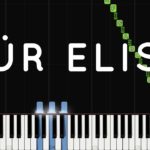
A step-by-step Piano tutorial on how to play the main section from Fur Elise by Ludwig van Beethoven (Bagatelle No. 25 in A minor).
Bitesize Piano tutorials are FREE – If this was of value to you, please consider supporting the channel by contributing here:
https://paypal.me/bitesizepiano
http://patreon.com/bitesizepiano
Connect with me!
Subscribe on Youtube: https://www.youtube.com/channel/UC2uFgGbE2fb1GWal9SOmOhQ?sub_confirmation=1
Website: http://bitesizepiano.co.uk
Facebook: https://www.facebook.com/BitesizePianoLessons/
Twitter: https://twitter.com/bitesizepiano
STEP-BY-STEP PIANO TUTORIALS: https://www.youtube.com/watch?v=SZfUEWXCmRQ&list=PLJOfTzSYW-9qZAqdpwllxsjfOL5tBAQrf
FILM/TV THEME PIANO TUTORIALS: https://www.youtube.com/watch?v=M9-RKhh87Wg&list=PLJOfTzSYW-9pZjixE0sHazC2Y-Exyu0WE
EASY PIANO TUTORIALS: https://www.youtube.com/watch?v=9ZoyZ2BO3sw&list=PLJOfTzSYW-9q2WSmGH1CNjmP3–2qaXN5
Some general information about Fur Elise:
Fur Elise was not published during Beethoven’s lifetime, only being discovered (by Ludwig Nohl) forty years after his death, and may be termed either a Bagatelle or an Albumblatt. The identity of “Elise” is unknown; researchers have suggested Therese Malfatti, Elisabeth Röckel or Elise Barensfeld.
The piece is basically in rondo form, ABACA. It is in A minor and in 3/8 time. It begins with an A minor theme marked ‘Poco moto’ (in some motion), with the left hand playing arpeggios alternating between A minor and E major. The same motifs follow around C major and G major, before returning to the original theme.
It has been suggested that the letters that spell ‘Elise’ can be decoded as the first three notes of the piece. Because an E♭ is called an Es in German and is pronounced as “S”, that makes E–(L)–(I)–S–E: E–(L)–(I)–E♭–E, which by enharmonic equivalents sounds the same as the written notes E–(L)–(I)–D♯–E.
#furelise #ludwigvanbeethoven #bitesizepiano
http://leedspianoteacher.co.uk