Wikipedia :
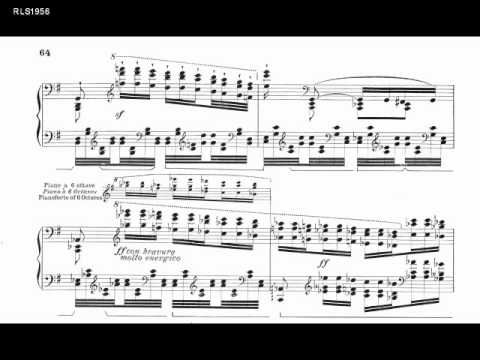
The Grandes Etudes de Paganini are a series of six etudes for the piano by Franz Liszt, revised in 1851 from an earlier version (published as Études d’exécution transcendante d’après Paganini, S.140, in 1838). It is almost exclusively in the final version that these pieces are played today.
The pieces are all based on the compositions of Nicolo Paganini for violin, and are among the most technically demanding pieces in the piano literature (especially the original versions, before Liszt revised them, thinning the texures and removing the more outrageous technical difficulties). The pieces run the gamut of technical hurdles, and frequently require very large stretches by the performer of an eleventh (although all stretches greater than a tenth were removed from the revised versions).
Liszt first heard Paganini in April 1831 and was so entranced by the unfettered expressiveness of his playing, and Paganinis ability to use his legendary technical ability for purely musical ends, that the young Liszt immediately declared his intention of achieving upon the piano an equivalent new technical mastery in order to unleash musical thoughts which had remained hitherto inexpressible.
Liszt and Schumann (who both rated Paganini very highly as a composer) began the trend of writing pieces on Paganinis themes in 1831/2: Schumann first with a sketched work for piano and orchestra, and then his first set of six Studies (opus 3) on Paganinis Caprices, and then Liszt following with his Grande Fantaisie de bravoure sur La Clochette (S.420) based upon the third movement of Paganinis Second Violin Concerto. Schumann later wrote a second set of six piano studies (opus 10), and then at the end of his creative life produced piano accompaniments to Paganini’s Caprices (an accomplishment later echoed by Szymanowski). Liszt wrote a set of six studies in 1838 (S.140), sketched a further fantasy [combining the Clochette theme with the Carnaval de Venise] in 1845 (S.700), and rewrote the six studies into their commonly-known final version in 1851 (S.141).
Paganinis 24 Caprices for Solo Violin, Op 1, were composed during the early years of the nineteenth century, and were published in 1820. They pay homage to a like-named work by Pietro Locatelli, and were of incalculable influence upon whole generations of violinists, and – just as importantly – composers. They form the basis for all but one of Liszts Études dexécution transcendante daprès Paganini, and Liszt remains very faithful to Paganinis text. (It is interesting that, although these works are really transcriptions, they are always catalogued and published as original Liszt works. Certainly there is a wealth of original thinking in what Liszt wrote, but the basic material and structure remain Paganinis.) Liszt dedicated the 1838 set of studies to Clara Schumann and – typical of his generosity and magnanimity – went on happily to dedicate the 1851 set to her as well, in spite of her carping ingratitude (see note to Etude No. 1, below).
Etude No. 4 (E major)
Paganinis first Caprice (which quotes Locatellis seventh) is the basis for Liszts fourth study. In the first edition it appears in two versions: the first as a single-note arpeggio in each hand, the second (and more difficult) with double-note arpeggios in both hands. Even though they are both marked Andante quasi Allegretto, they inhabit the very edge of the technically-possible with their stretches, leaps and hand-crossings. Liszt adds grand melodic lines in counterpoint to the straightforward broken chords of the original. In the 1851 version the piece is marked Vivo and the music is printed, uncannily like Paganinis original to the casual view, on one stave; the hands intricately alternate in a neatly-woven replica of the Caprice, shorn of all added melodies.
Etude No. 4 (E major)
Paganinis first Caprice (which quotes Locatellis seventh) is the basis for Liszts fourth study. In the first edition it appears in two versions: the first as a single-note arpeggio in each hand, the second (and more difficult) with double-note arpeggios in both hands. Even though they are both marked Andante quasi Allegretto, they inhabit the very edge of the technically-possible with their stretches, leaps and hand-crossings. Liszt adds grand melodic lines in counterpoint to the straightforward broken chords of the original. In the 1851 version the piece is marked Vivo and the music is printed, uncannily like Paganinis original to the casual view, on one stave; the hands intricately alternate in a neatly-woven replica of the Caprice, shorn of all added melodies.
Source :
http://en.wikipedia.org/wiki/Grandes_Etudes_de_Paganini
Video made by : rodolforavissant@hotmail.com