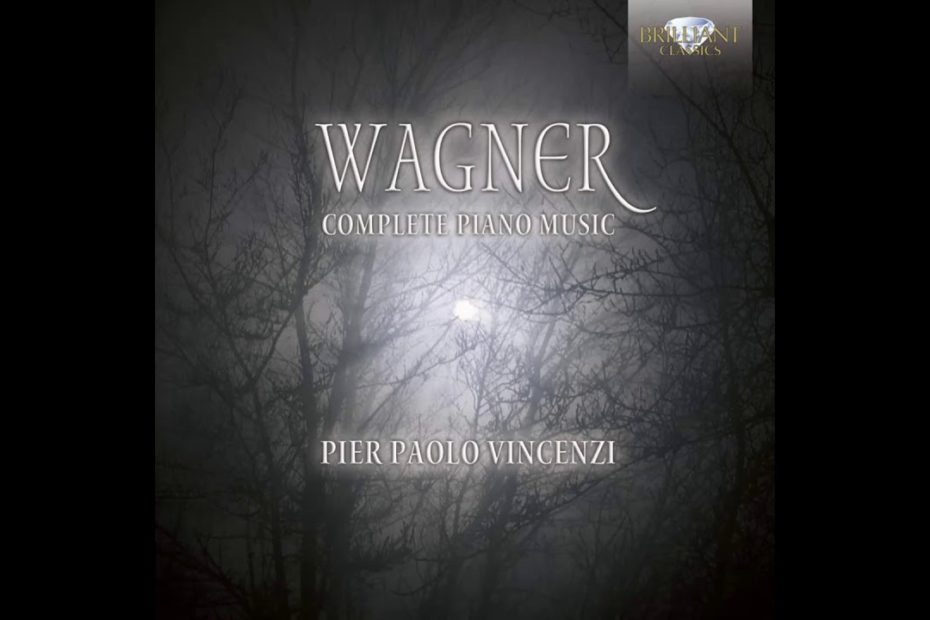
Performed by Pier Paolo Vincenzi
I – Allegro con moto: 0:00
II – Adagio molto e assai espressivo: 8:46
III – Maestoso – Tempo moderato e maestoso – Allegro molto: 22:27
In thrall to music and avid to compose, the adolescent Wagner, responding ardently to every performance and score that crossed his path, committed to paper a number of works either lost or buried beneath the weight of his later fame. Encountering a Haydn quartet in score, for instance, he composed one of his own, now lost. No prodigy, he played the piano acceptably (it was suggested he take lessons from Hummel) and essayed several tortuous weeks of violin lessons.
But if he was not conspicuously gifted as a musician, he soon became a fluent score reader. Don Giovanni and the late Beethoven quartets and sonatas became his daily bread. Haphazardly, he took instruction in the rudiments of harmony without gaining more than a modicum of compositional command, supplemented by indefatigable energy and ambition. Mounting frustration led him to seek tutelage from Theodor Weinlig, cantor of Leipzig’s Thomaskirche (where J.S. Bach had served 80 years before). By now, Wagner was in his 18th year and, knowing beyond a doubt that music was his vocation, he settled in, from October 1831 to March of the following year, to a course of study wisely oriented by Weinlig toward composition.
The analysis of a Pleyel piano sonata, for instance, with ancillary instruction in the rudiments of fugue and canon, would be followed by the composition of a Wagner piano sonata. The first of these, in B flat, was dedicated to Weinlig, who persuaded the firm of Breitkopf und Härtel to publish it. His second sonata, subtitled Grand Sonata, was probably composed in early 1832, originally structured in four movements with a hilariously foursquare fugue of 41 bars that would delete later. Compared with the B flat major sonata, Wagner leaves the Pleyel influence to unabashedly exhibit the potent impress of Beethoven’s Sonatas.
The first movement, written in sonata form, opens with a premonitory motif related to the opening “fate” motif of Beethoven’s Fifth Symphony. The main theme (based on the opening motif) is impetuous and passionate, followed by a lyrical and soulful second theme as a strong contrast. Both themes are completely reexposed. The development is more complex and prolix than in the previous sonata, with the opening motif appearing constantly. The recapitulation reexposes again the two themes. When seems that the second theme is going to be repeated, an ambiguous coda ends the movement.
The second movement is the real core of the work, structured on the alternacy of two themes. It begins with a pensive main theme, full of a tragic feeling. After the development, a second theme is presented, strongly intimate and lyrical in character and a more positive contrast. The first theme is reexposed in a varied way, then the secondary themes comes again, with little changes. Then the main theme is presented again, with a new extensive development. The second theme comes again on a more ornamented way. The movement ends after a brief and dark coda.
The third movement is written in sonata form. It opens with a majestic introduction through a series of chords. The main theme is energic, followed by a pompous and more calm second theme. As usuall in Wagner’s sonatas, both themes are reexposed. The brief fugue featured in the original score has been removed by the own composer, following a short development. The themes are recapituated. The work ends permeated with blithesome high spirits.
Where the B flat Sonata moved mechanically through its sonata form tropes with fulsome Gemülichkeit and obstreperous bonhomie, the Grosse Sonata carries one through an arresting and often moving compositional trajectory. The first two movements were recomposed for an ultimately abandoned Symphony in E major in 1834.
Sources: https://www.allmusic.com/composition/piano-sonata-in-a-major-wwv-26-op-4-mc0002365505 musical analysis done by myself


関連記事:
 ワーグナー ニュルンベルクのマイスタージンガー 前奏曲 2台8手版 Wagner / Prelude from Die Meistersinger von Nurnberg 8手連弾 ピアノ
 ビューロー, ハンス・フォン:「ニュルンベルクのマイスタージンガー」(ワーグナー)第3幕の五重唱によるパラフレーズ pf. 林川 崇:Hayashikawa, Takashi
 Richard Wagner – Sonata para Piano en La Bemol.
 Richard Wagner – Menuetto from the Sonata (1831) played by Nina Kavtaradze